Security
Cloud security architecture
Cloud security architecture is the design of the controls that protect workloads in a cloud account, layered across identity, network, compute and data.
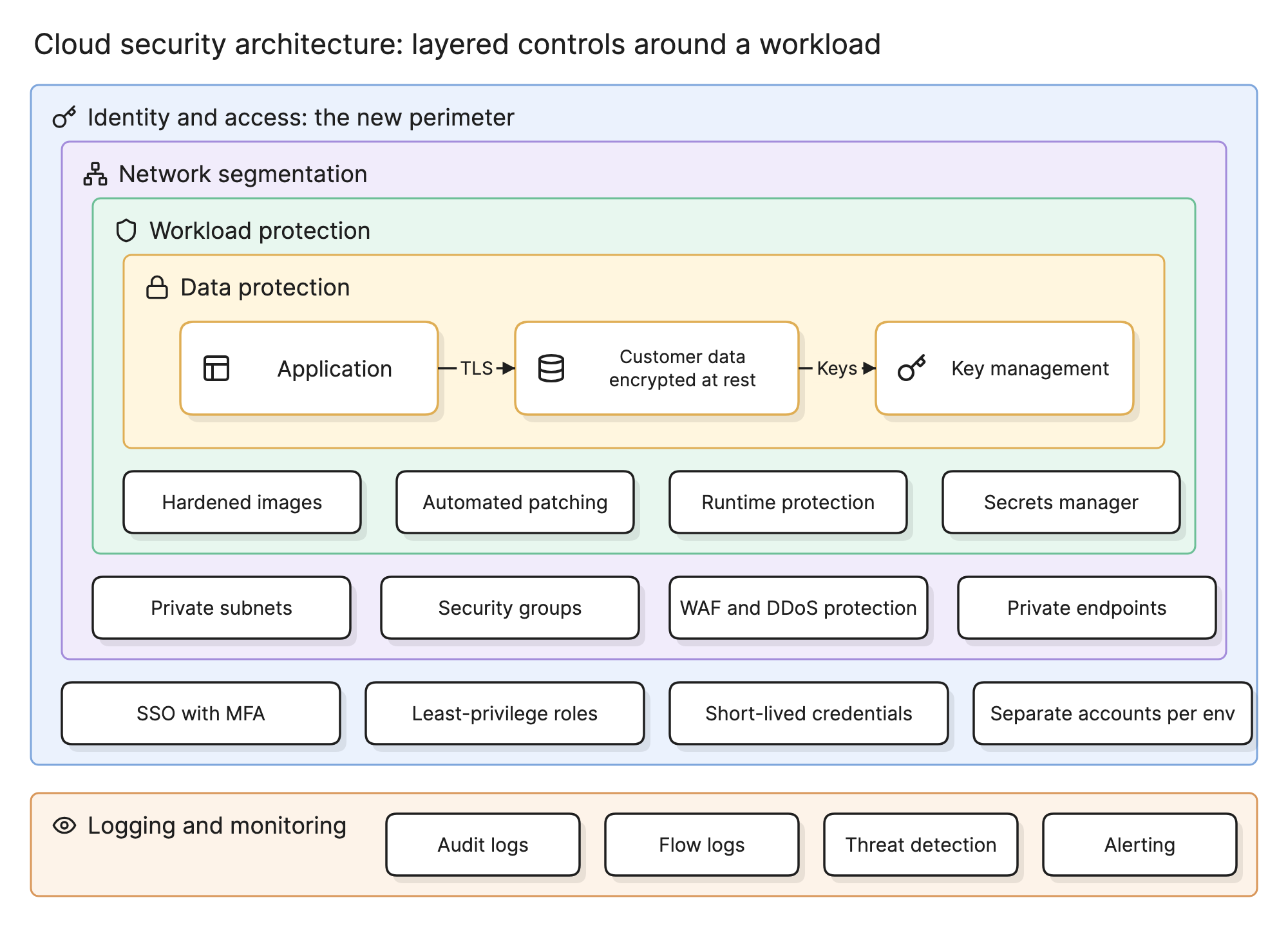
Teams write down a cloud security architecture because the cloud makes every control a configuration choice, and a hundred small choices across accounts, networks and services only add up to security if someone designed how they fit.
Why does cloud security architecture matter?
- Misconfiguration is the main risk. Most cloud incidents trace to an open bucket, an over-broad role or a public database rather than a clever exploit.
- Controls interact. A private subnet is pointless if the instance has a role with full permissions. Only a view of all the layers shows the gaps between them.
- Teams need a reference. Application teams ship faster when the account layout, network paths and identity rules are drawn once.
What are the layers of cloud security architecture?
The diagram at the top of this page shows the layers as nested regions around a workload. Reading from the outside in:
- Identity and access. Who and what can act in the account. Single sign-on with MFA for people, least-privilege roles for services, short-lived credentials instead of long-lived keys and separate accounts per environment so a mistake in staging cannot reach production.
- Network segmentation. Where traffic can flow. Private subnets for anything the internet does not need to reach, security groups that allow only named paths, a web application firewall and DDoS protection in front of public endpoints and private endpoints for managed services.
- Workload protection. The compute itself. Hardened base images, automated patching or image replacement, runtime protection that notices unexpected processes and a secrets manager so no credential lives in code or environment variables.
- Data protection. The innermost layer. Encryption at rest for every store, TLS for every connection, keys held in a key management service with rotation and access logging and encrypted, tested backups.
- Logging and monitoring. A band that watches all of the above: audit logs of every API call, network flow logs, threat detection over both and alerting that reaches a person.
What is the shared responsibility model?
The provider secures the cloud; you secure what you put in it. Where the line falls depends on the service.
| Service type | Provider secures | You secure |
|---|---|---|
| Virtual machines | Hardware, hypervisor, physical network | OS, patches, network rules, identities, application, data |
| Containers and managed Kubernetes | The above plus the control plane | Images, pod policies, network policies, identities, data |
| Managed databases and functions | The above plus the OS and runtime | Configuration, access control, encryption settings, data |
| SaaS | Everything except your settings | Identities, sharing settings, data classification |
The common mistake is assuming the provider’s share is bigger than it is. Encryption at rest is available everywhere, but turning it on, choosing who holds the key and restricting who can read the data are on your side of the line.
How do you read a cloud security architecture diagram?
Start at the data in the middle of the hero diagram and work outward, asking what an attacker needs at each layer. To read customer data, someone needs a key, which the key management service grants only to the application’s role. To reach the application, traffic has to pass the security groups, which admit only the load balancer. To change any of that, a person needs a role, which requires SSO with MFA and is scoped to one environment.
Then read the bottom band. Every layer emits logs, and threat detection correlates them. If an attacker steals a credential and starts listing storage buckets from an unusual location, the identity layer did not stop them, but monitoring should notice within minutes. That is defense in depth: no single control is trusted to hold.
How do you design a cloud security architecture?
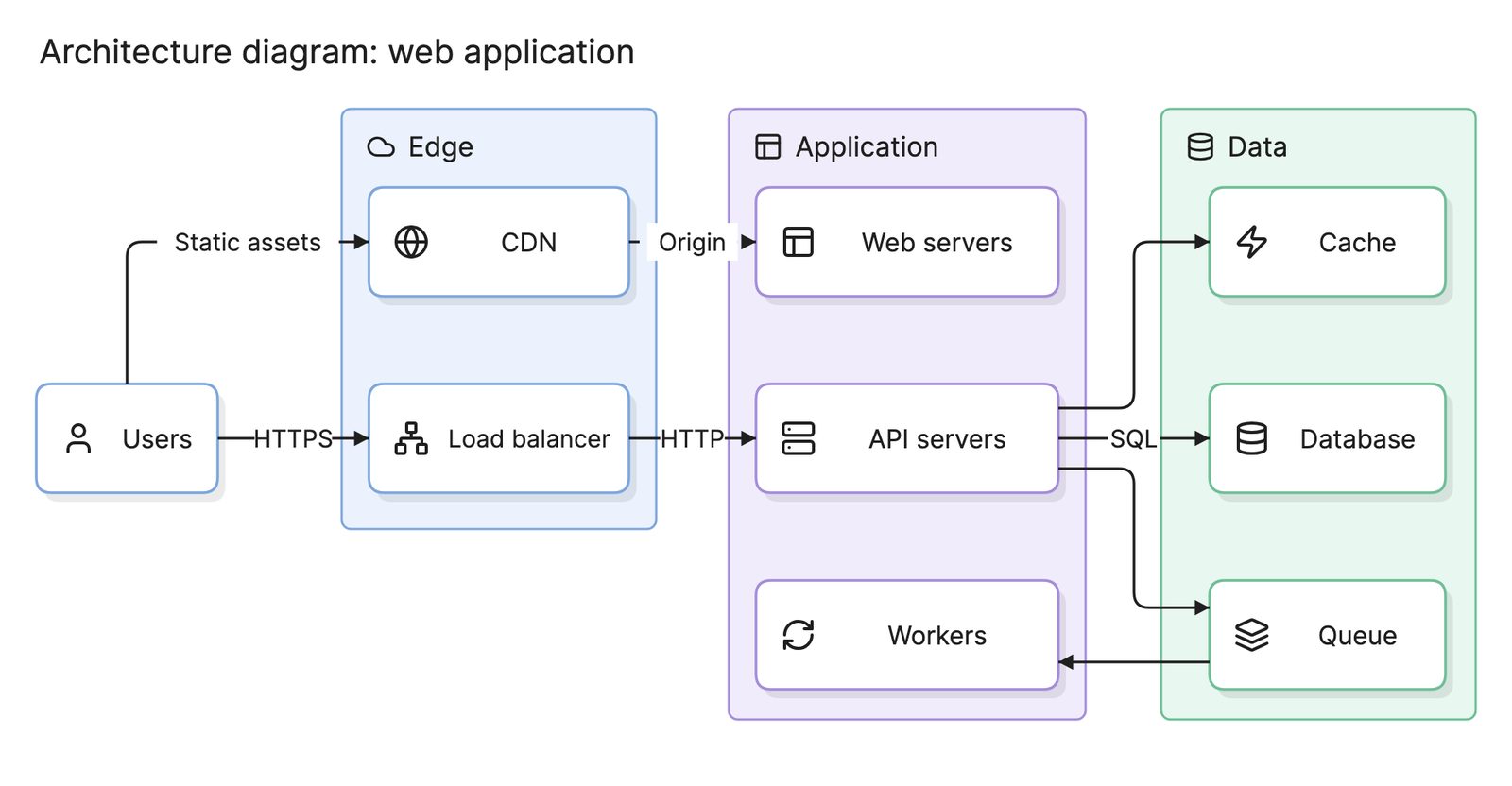
- Inventory the data. Classify what you store, mark the sensitive stores on an architecture diagram and draw a data flow diagram of where each class moves.
- Draw the account structure. One account or project per environment and per major system, joined under an organization with central logging.
- Design identity first. Federate people through single sign-on, give services roles instead of keys and write the least-privilege policies.
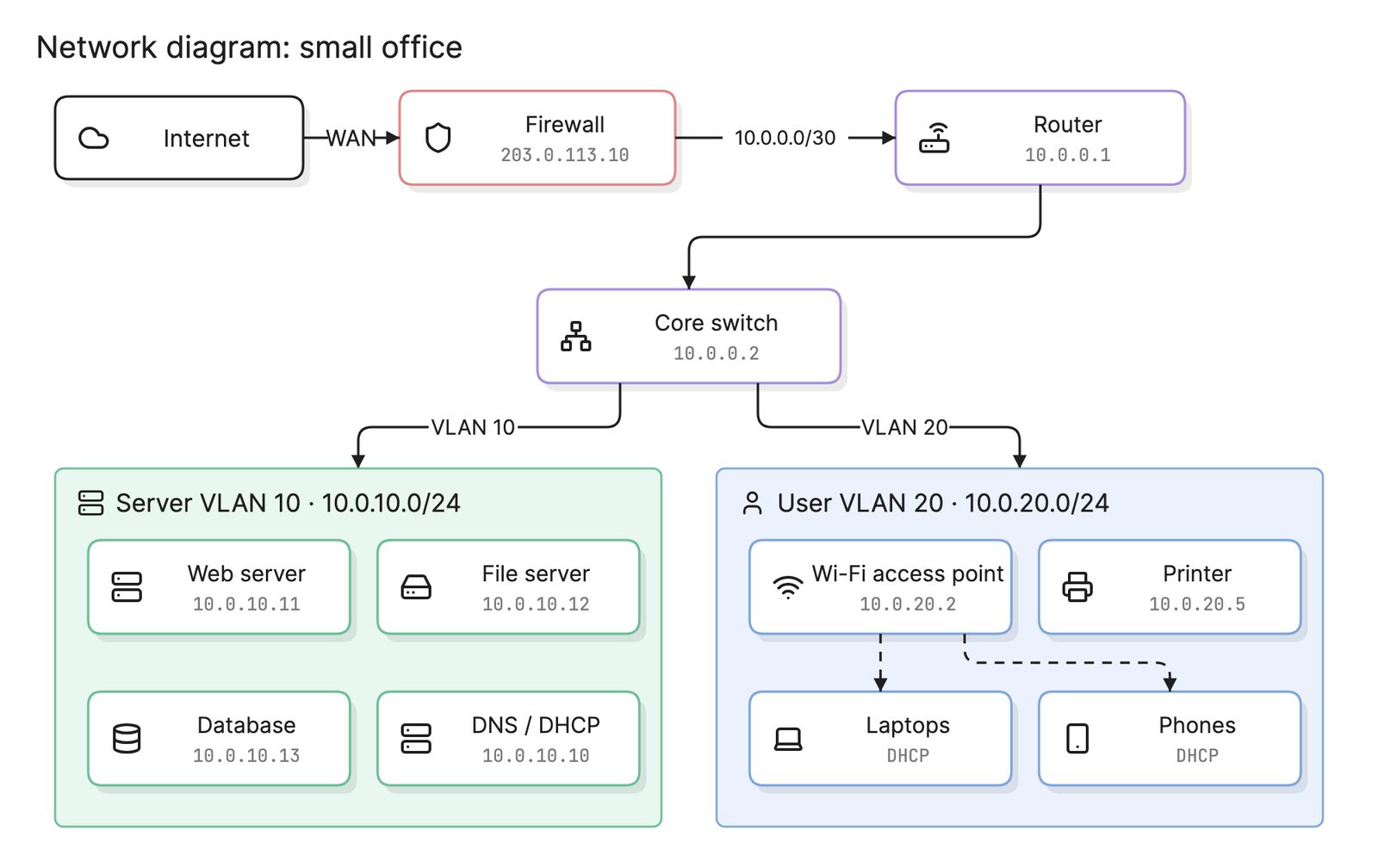
- Segment the network. Draw a network diagram of subnets and allowed paths, with nothing public that does not have to be.
- Harden workloads and data. Choose base images, patching cadence, secrets handling and encryption keys per data class.
- Wire up monitoring. Turn on audit and flow logs everywhere, route them to one place and define the alerts that page someone.
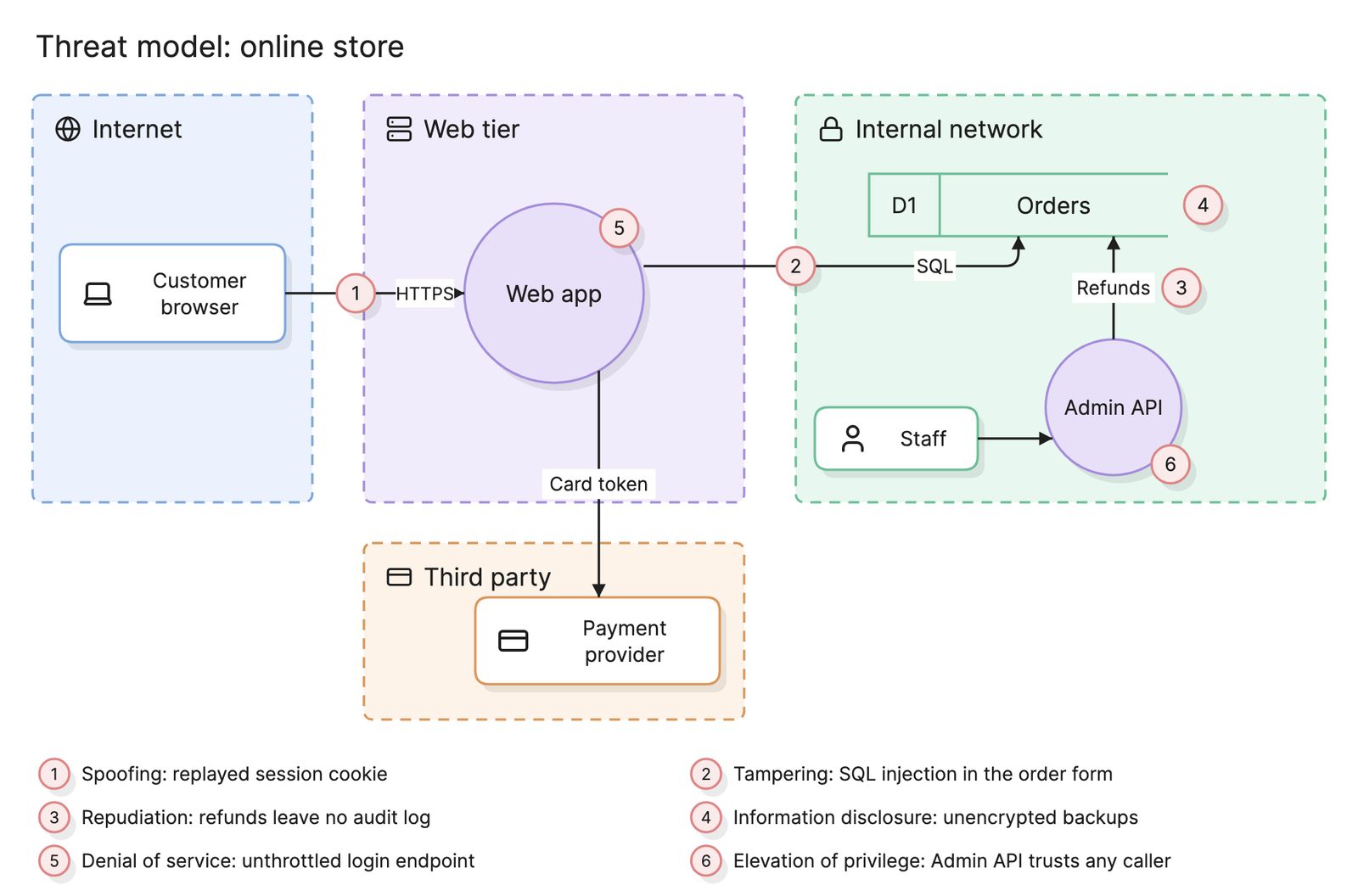
- Threat model the result. Run a threat modeling session against the diagram and fix what it finds before the first workload lands.
What are common cloud security architecture mistakes?
- Long-lived access keys. Keys in config files and CI secrets are the most stolen credential in the cloud.
- Public by accident. Buckets, databases and dashboards opened for a demo and never closed.
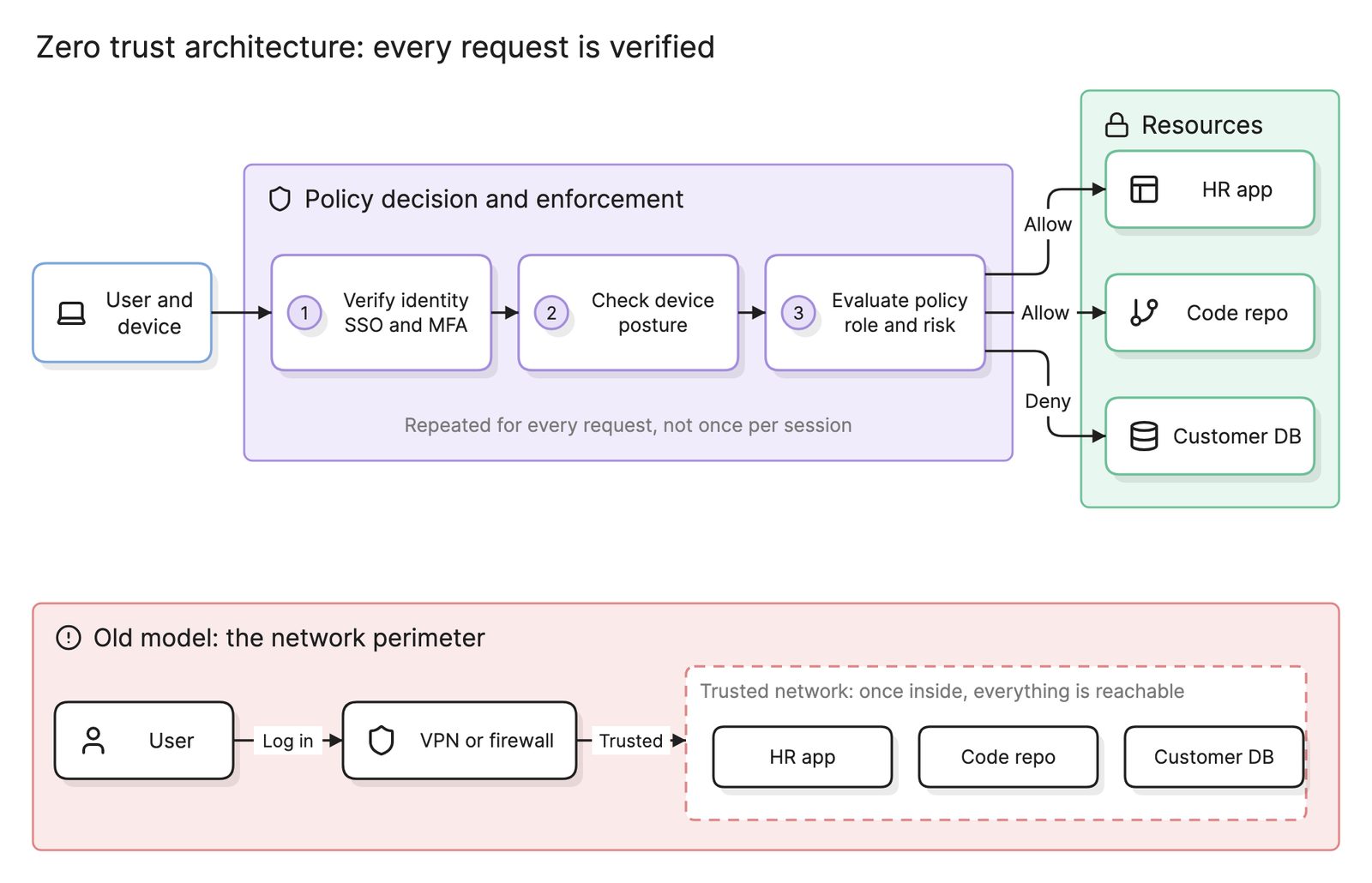
- Trusting the network alone. A flat private network where every service can call every other is the pattern zero trust architecture exists to replace.
How does cloud security architecture compare with related terms?
| Term | Scope | Question it answers |
|---|---|---|
| Cloud security architecture | A cloud account or organization | What controls protect our workloads, in layers? |
| Zero trust architecture | Access to resources, anywhere | How is every request verified? |
| Threat modeling | One system at a time | What can go wrong here, and what do we do about it? |
| Network diagram | The network layer only | How are the subnets, gateways and firewalls connected? |
An API gateway usually sits at the edge of the network layer, where it enforces authentication and rate limits for every public endpoint.
What tools help with cloud security architecture?
- Cloud security posture management. Services that scan an account’s configuration against benchmarks and flag public buckets, over-broad roles and unencrypted stores.
- Infrastructure as code with policy checks. Accounts, networks and roles defined in code, with rules that fail a pull request when it opens a port or widens a permission.
- AI diagramming tools. Tools like Eraser turn infrastructure code or a description of an account into a cloud architecture diagram you can keep editing, which gives a security review something accurate to look at.
For more on this kind of diagram, see architecture diagrams.
Frequently asked questions
-
What is the shared responsibility model?
The cloud provider secures the infrastructure it runs: data centers, hardware, the hypervisor and managed services up to the interface you configure. You secure everything you configure and deploy: identities, network rules, operating systems on your instances, application code and data. The line moves with the service type, higher for managed services, lower for raw virtual machines.
-
Why is identity called the new perimeter?
In a data center the firewall decided who was inside. In the cloud, every resource has an API that can be called from anywhere with the right credentials, so the credential is the boundary. A leaked access key defeats every network control, which is why identity sits as the outermost layer in the diagram above.
-
What is defense in depth?
Defense in depth means placing independent controls in layers so a single failure does not expose the data. If a vulnerability lets an attacker run code on an instance, network segmentation still stops them reaching the database, encryption still protects the backups and monitoring still raises an alert. Each layer buys time.
-
How does cloud security architecture differ from on-premises security?
The controls are similar in purpose and different in form. Firewalls become security groups and network policies, network perimeters become account boundaries, and patching becomes replacing images. The biggest difference is that everything is configurable through an API, which makes misconfiguration the leading cause of cloud breaches and makes automated checks essential.