IT management
Application portfolio management
Application portfolio management inventories and scores an organization's applications to decide which to invest in, tolerate, migrate or eliminate.
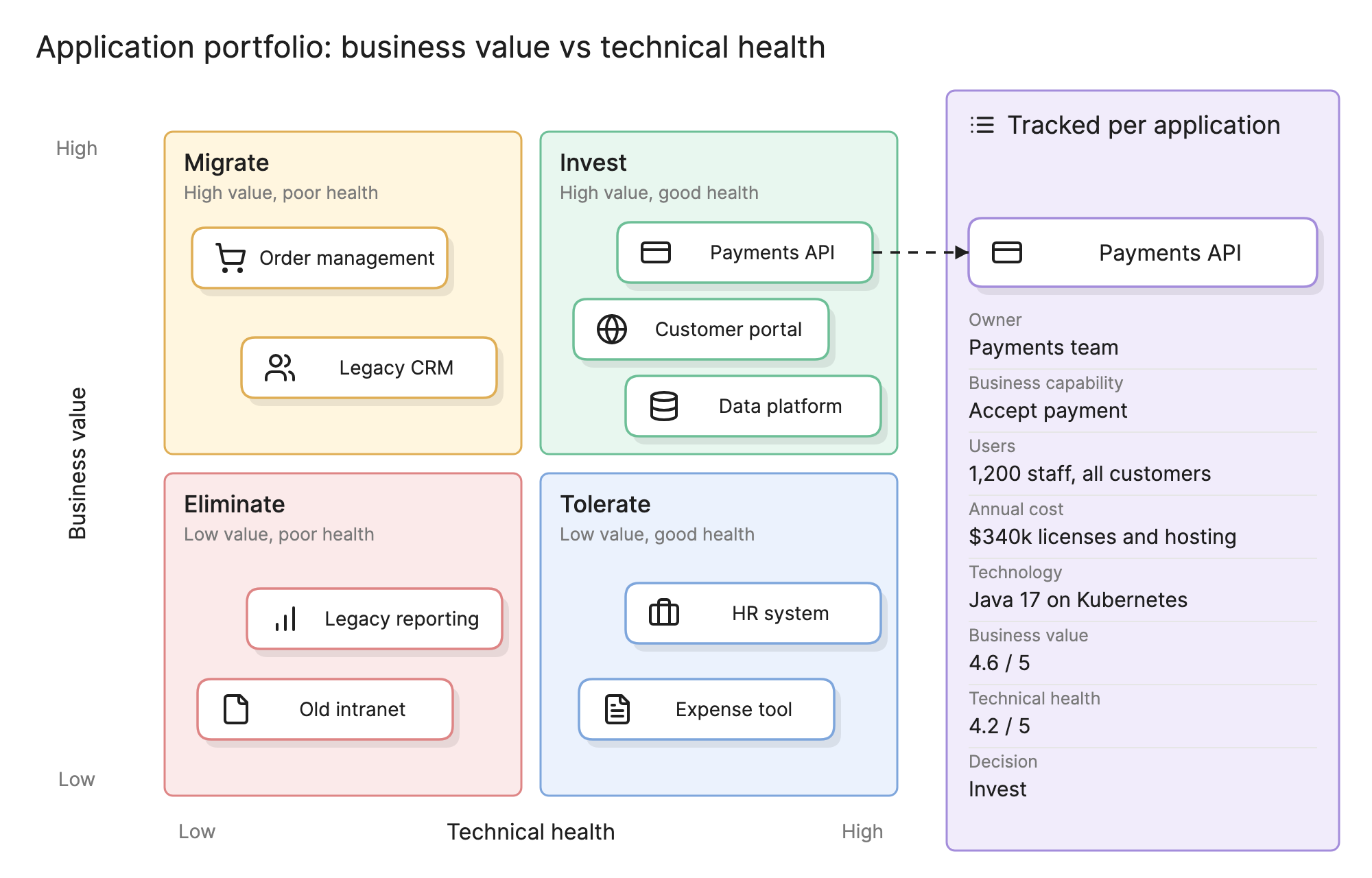
Most organizations run more applications than anyone can name, and the list grows through acquisitions, team-level purchases and projects that never quite finished. Application portfolio management (APM) gives IT and architecture leaders one place to see what they run, what it costs and which applications deserve money next year.
Why does application portfolio management matter?
- Cost. Overlapping tools, unused licenses and support contracts for systems with three users add up.
- Risk. Unsupported versions, single-person knowledge and applications nobody owns can only be fixed once they are known.
- Planning. An IT roadmap and a business capability map both need an honest list of what exists today.
- Rationalization. Application rationalization is a decision exercise, and the portfolio is the data it runs on.
What does an application portfolio track?
Each application gets one record with a stable set of attributes. The side panel in the diagram above shows a typical one.
| Attribute | Example | Why it is tracked |
|---|---|---|
| Owner | Payments team | Someone is accountable for the record and the decisions |
| Business capability | Accept payment | Ties the application to what the business does |
| Users | 1,200 staff, all customers | Scale of impact if it changes or fails |
| Annual cost | Licenses, hosting, support | Where the money goes |
| Technology | Java 17 on Kubernetes | Platform risk and the skills needed |
| Lifecycle | Active, sunset date | Whether it is coming or going |
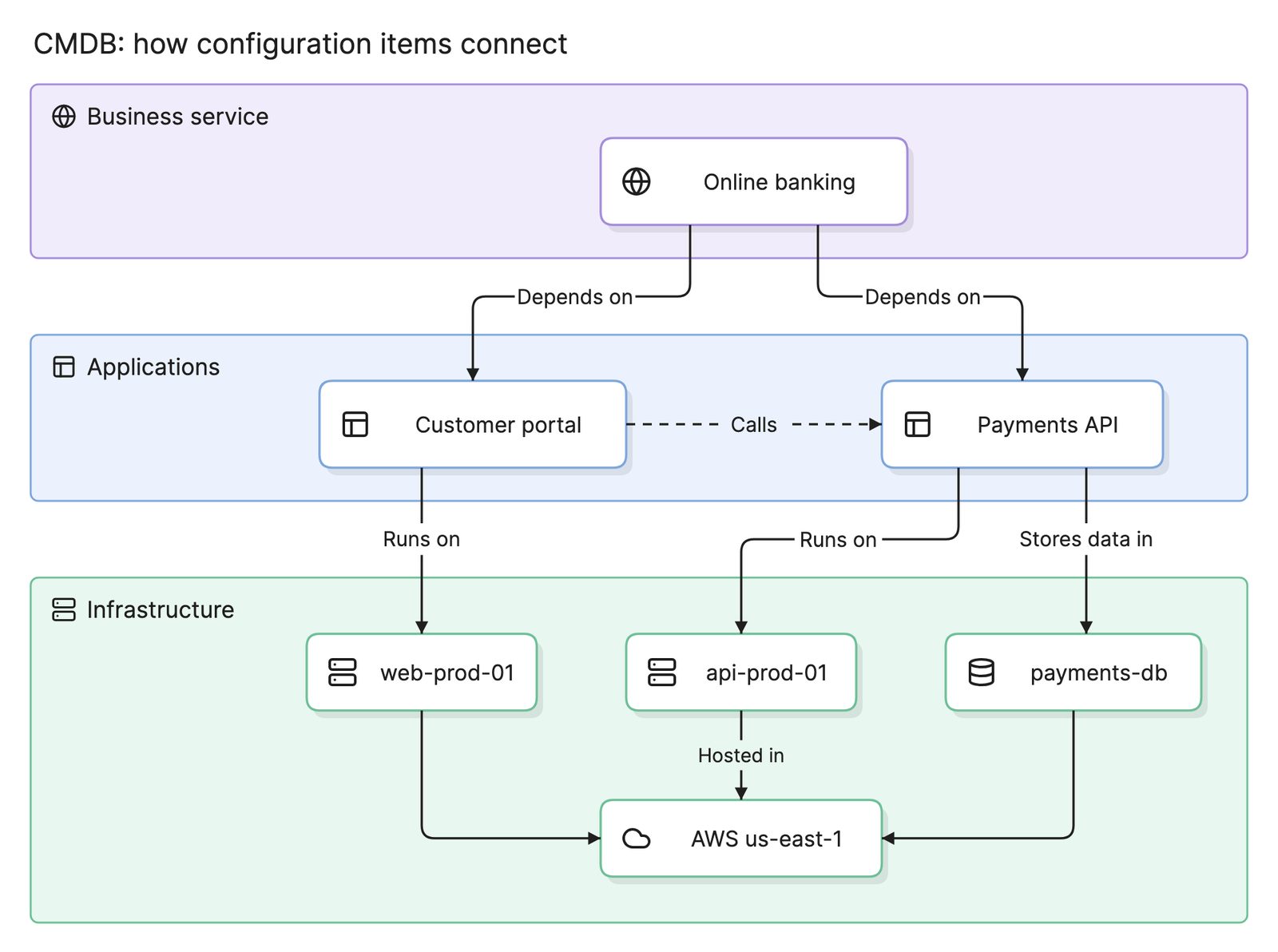
| Dependencies | Calls the fraud service | Shared with the CMDB and the dependency map |
An application portfolio is not a CMDB. The CMDB tracks configuration items and relationships down to the infrastructure, often thousands of them. The portfolio tracks applications as business assets, usually hundreds, with attributes the CMDB never holds, such as business value and a lifecycle decision. The two should share identifiers so a portfolio record can be traced to the servers beneath it through application dependency mapping or a service map. IT asset management is different again: it tracks what the organization owns and pays for rather than which applications are worth keeping.
How do you score applications?
Scoring turns opinions into comparable numbers. Most portfolios score two dimensions on a 1 to 5 scale and keep cost and risk as separate figures.
- Business value. How much the business depends on it: users, the revenue or process it supports, strategic fit and what would happen if it disappeared.
- Technical health. How supportable it is: version currency, vendor support, architecture, security posture, incident history and how hard it is to change. Accumulated technical debt lowers this score.
- Cost. Total annual cost, so a mediocre application that is nearly free is judged differently from an expensive one.
- Risk. Compliance exposure, data sensitivity and concentration on one vendor or one person.
A 4 for business value has to mean the same thing in finance as in logistics, so write the rubric down and have the same people apply it everywhere.
What is the TIME model?
The TIME model, from Gartner, plots business value against technical health and sorts the portfolio into four actions. It is the matrix in the diagram.
| Quadrant | Business value | Technical health | Typical action |
|---|---|---|---|
| Invest | High | Good | Fund new features and keep the team strong |
| Tolerate | Low | Good | Leave it alone and minimize spend |
| Migrate | High | Poor | Move it to a better platform or rebuild it; the business needs it |
| Eliminate | Low | Poor | Retire it, with a plan for its data and users |
The matrix is a prompt, not a verdict. An application in Eliminate with two years left on its contract may be tolerated until then, and one in Migrate may be replaced instead if a product already does the job.
How does APM feed rationalization and the roadmap?
The portfolio is a continuous record. Rationalization and the roadmap are what you do with it.
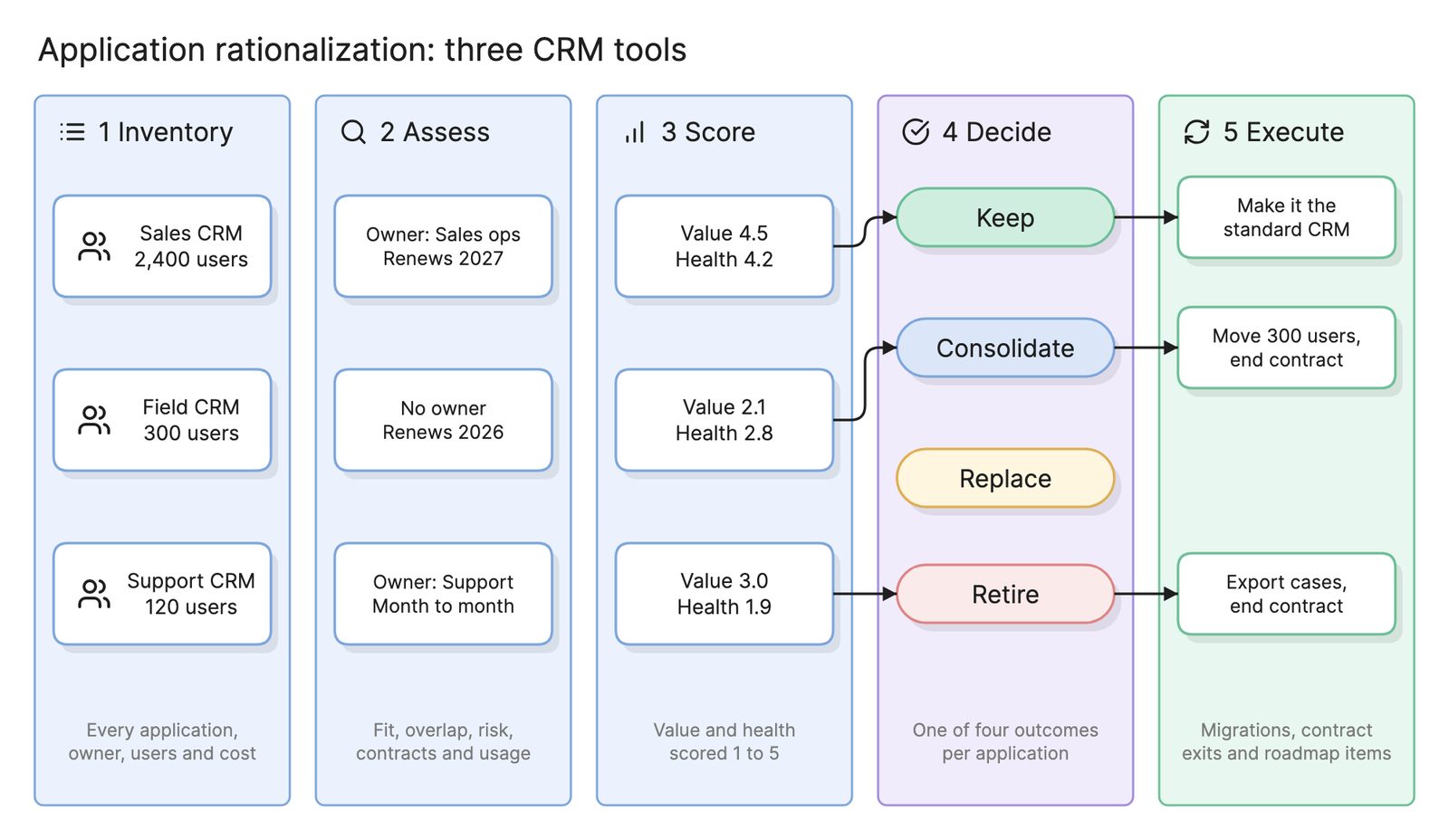
- Application rationalization takes a slice of the portfolio, often one capability or one business unit, and makes keep, consolidate, replace or retire decisions. Without a portfolio, the first half of every rationalization project is building the inventory.
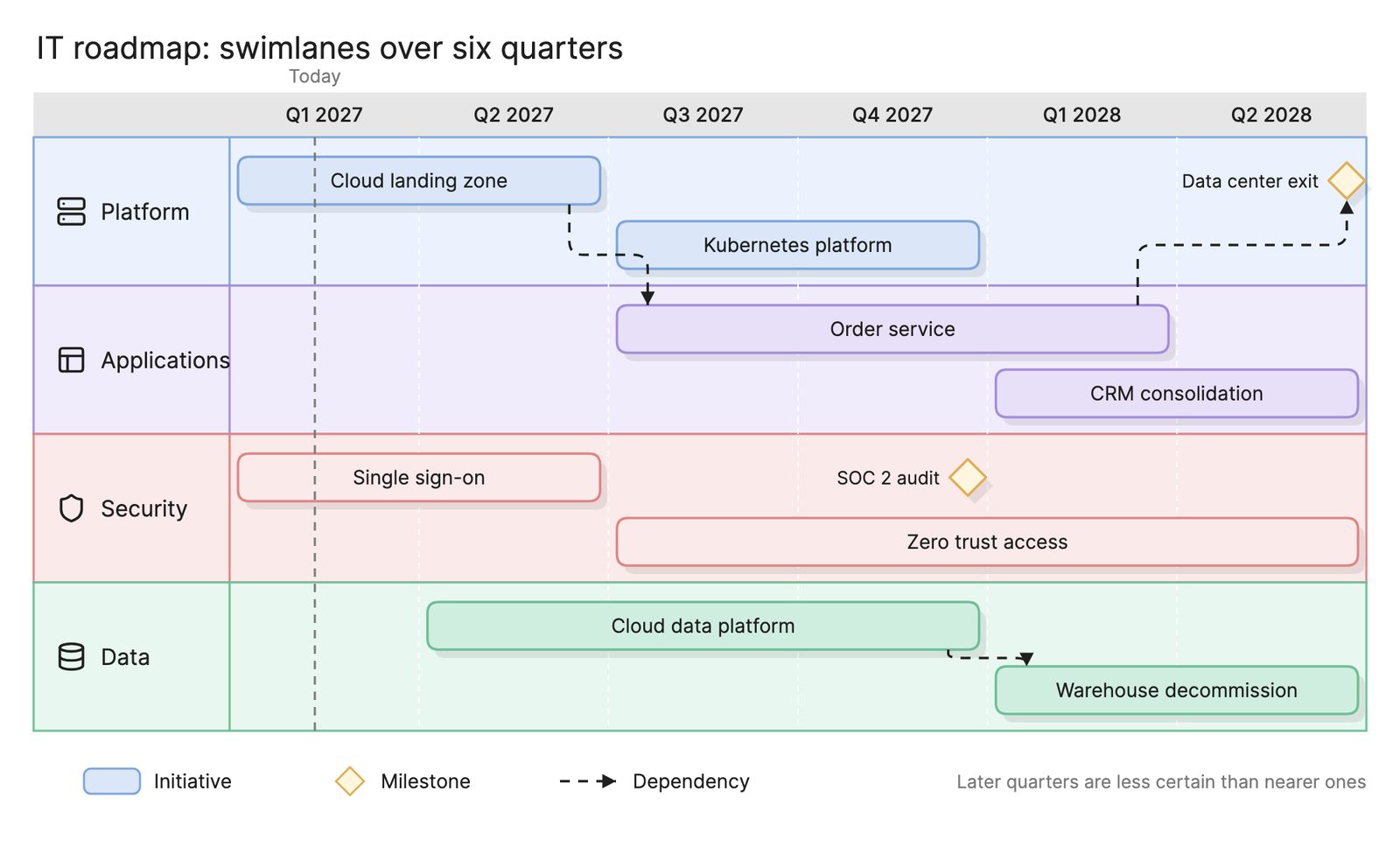
- The IT roadmap schedules those decisions: Migrate and Eliminate outcomes become dated, budgeted roadmap items and Invest outcomes become funded work.
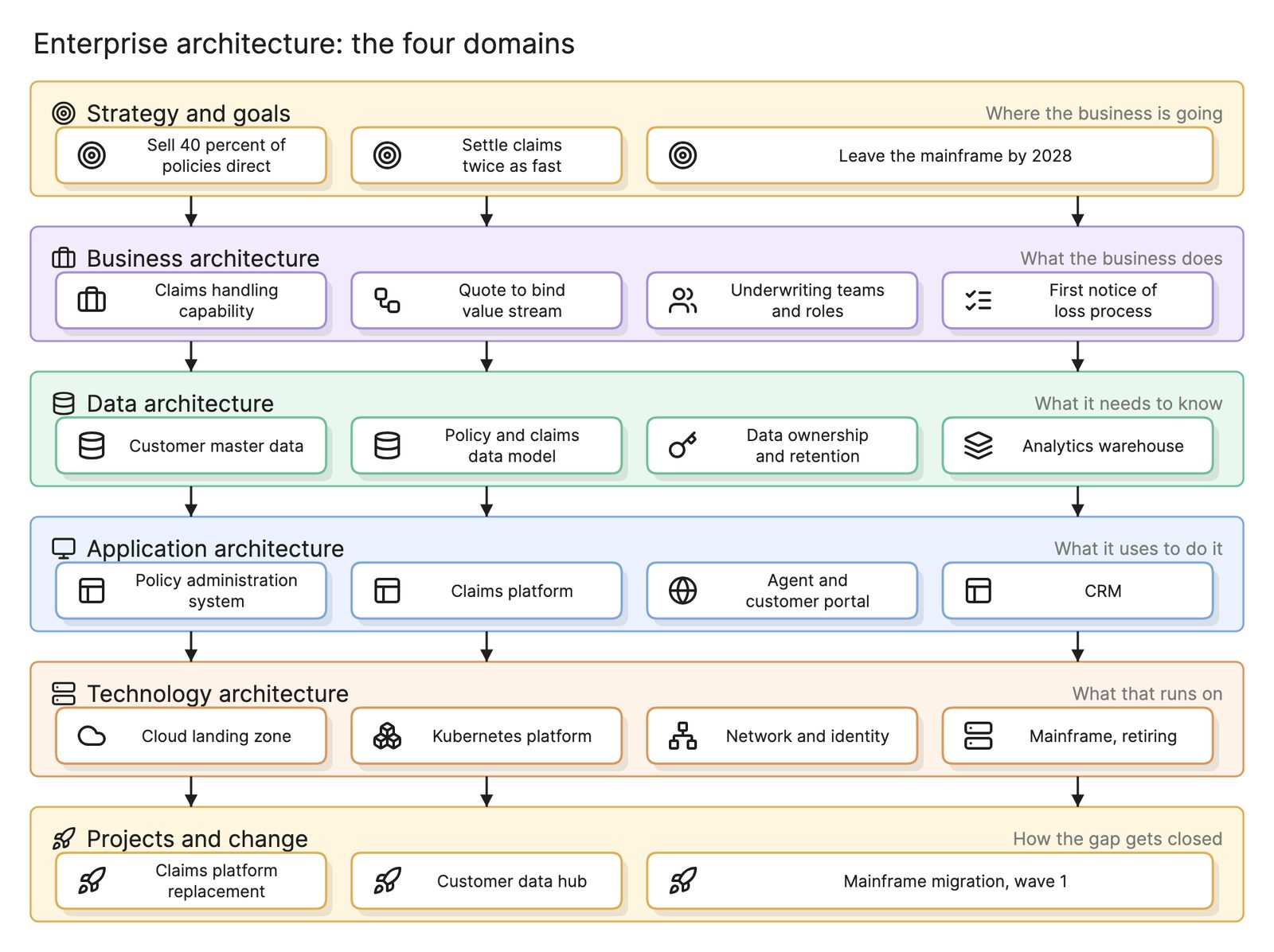
- Enterprise architecture maps applications to capabilities with it, and three applications under one capability is where consolidation candidates live.
How do you set up application portfolio management?
- Define an application. Decide what counts as one record: a product, a deployed instance or a module. Write it down, because every later count depends on it.
- Build the inventory. Start from the CMDB, license records, cloud accounts and single sign-on logs, then confirm with teams. Expect to find applications nobody listed.
- Assign owners. Every record needs a named business owner and a technical owner.
- Agree the scoring rubric. Keep it short, with a written definition for each score.
- Score and plot. Score in workshops with owners present, then plot the matrix.
- Connect it. Link records to capabilities, to CMDB services and to the roadmap, so the portfolio is used rather than filed.
What are common application portfolio management mistakes?
- A one-off inventory. A spreadsheet built for one project is out of date within a quarter.
- Scoring by one side. IT scoring business value alone, or the business scoring technical health, produces numbers nobody else trusts.
- No link to action. A plotted matrix that never reaches the roadmap or a budget is a poster.
- Ignoring dependencies. Eliminating an application that three others call is a different project from eliminating one that stands alone.
What tools help with application portfolio management?
- Spreadsheets. The usual starting point for a few dozen applications. They do not scale and they connect to nothing.
- Enterprise architecture and APM platforms. They hold the inventory, scores and capability maps with review workflows, and need discipline to keep current. Some sit inside an ITSM platform and read the business applications already in its CMDB; see ServiceNow CMDB and CSDM.
- Connected architecture maps. Tools like Eraser draw the application landscape from live sources such as a CMDB and cloud accounts, so the portfolio sits next to the dependencies and infrastructure it describes rather than in a separate list.
Frequently asked questions
-
What is the difference between application portfolio management and IT asset management?
IT asset management tracks what the organization owns and pays for: hardware, licenses, contracts and their lifecycle dates. Application portfolio management tracks applications as business assets and asks whether each one is worth keeping, with scores for value, health, cost and risk. A license record in asset management often becomes the cost line in the portfolio.
-
What is the TIME model?
TIME stands for tolerate, invest, migrate and eliminate. It is a Gartner framework that plots each application by business value against technical health and sorts the result into four actions. It is the most common way to turn portfolio scores into a first set of decisions, which cost, contract dates and dependencies then refine.
-
Who owns application portfolio management?
Usually the enterprise architecture function, with the inventory maintained jointly with IT operations and finance. Each application also has a named business owner who signs off on its scores and decisions. Without that split the portfolio becomes an IT list that the business does not recognize and will not fund decisions from.
-
How often should you review the application portfolio?
Rescore the whole portfolio once a year, aligned with budget planning, and update individual records whenever an owner, cost, contract or lifecycle date changes. Teams that review only during a rationalization project rebuild the inventory each time, which is the most expensive way to keep one.