IT management
Enterprise architect
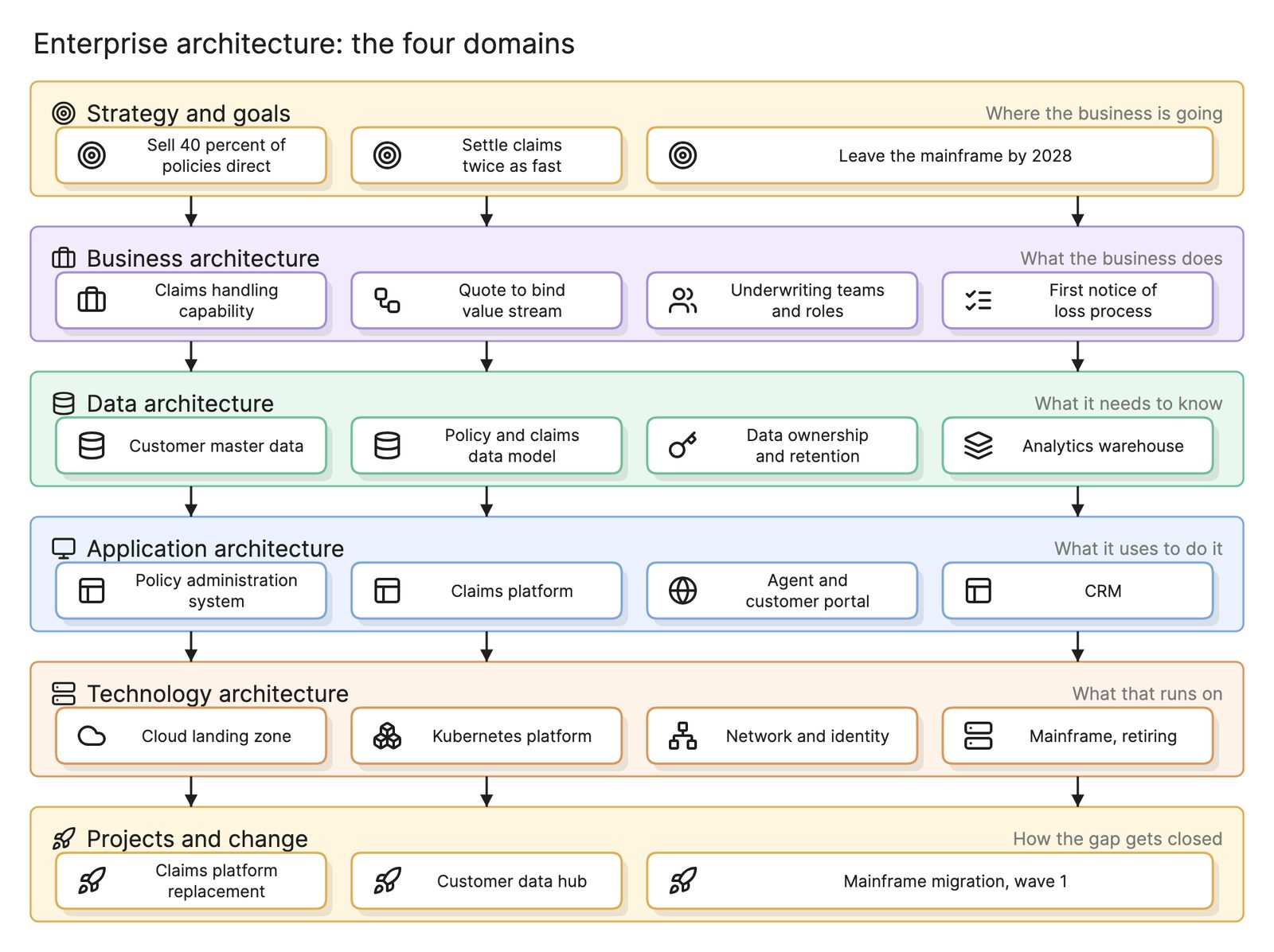
An enterprise architect owns an organization's target architecture across business, data, applications and technology and the roadmap for reaching it.
Organizations create the enterprise architect role when strategy and systems have drifted apart: the board announces a direction, the IT estate cannot deliver it and nobody can explain the gap. The enterprise architect is the person accountable for enterprise architecture as a whole: for knowing what exists, deciding what should exist and setting the rules that get the organization from one to the other.
What does an enterprise architect do?
- Translates strategy into a target architecture. Takes goals from executives and works out which capabilities, applications and platforms the organization needs to meet them.
- Keeps the current state honest. Owns the application portfolio and the landscape view, fed by the CMDB, cloud inventories and application portfolio management.
- Writes the roadmap. Sequences the projects and transition states that move the estate toward the target. See IT roadmap.
- Sets standards and patterns. Publishes principles, reference architectures and approved technologies so projects do not reinvent the same choices.
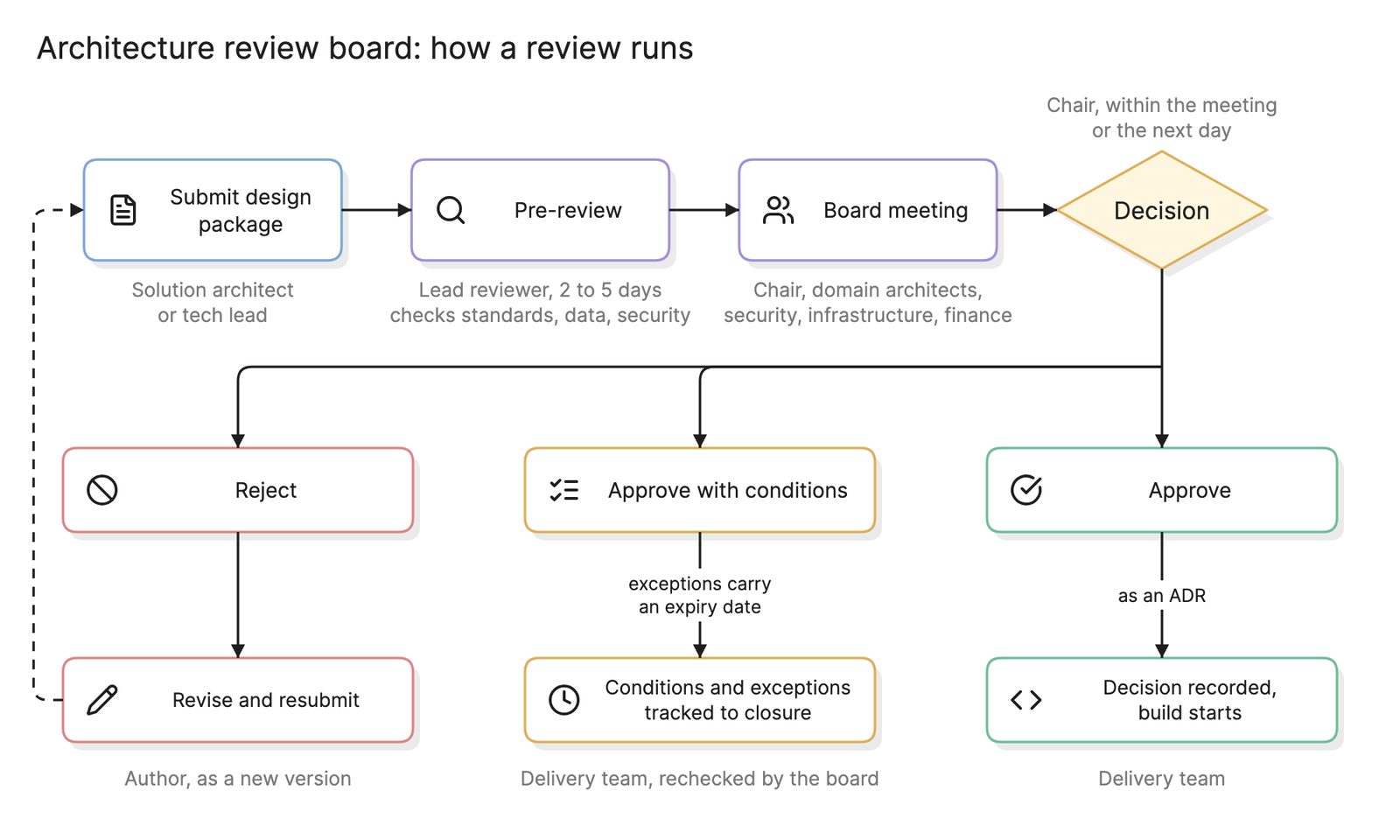
- Governs designs. Chairs or sits on the architecture review board, where significant solution designs are checked against the target.
- Builds the case for change. Turns rationalization and modernization into business cases finance will sign.
What does an enterprise architect own?
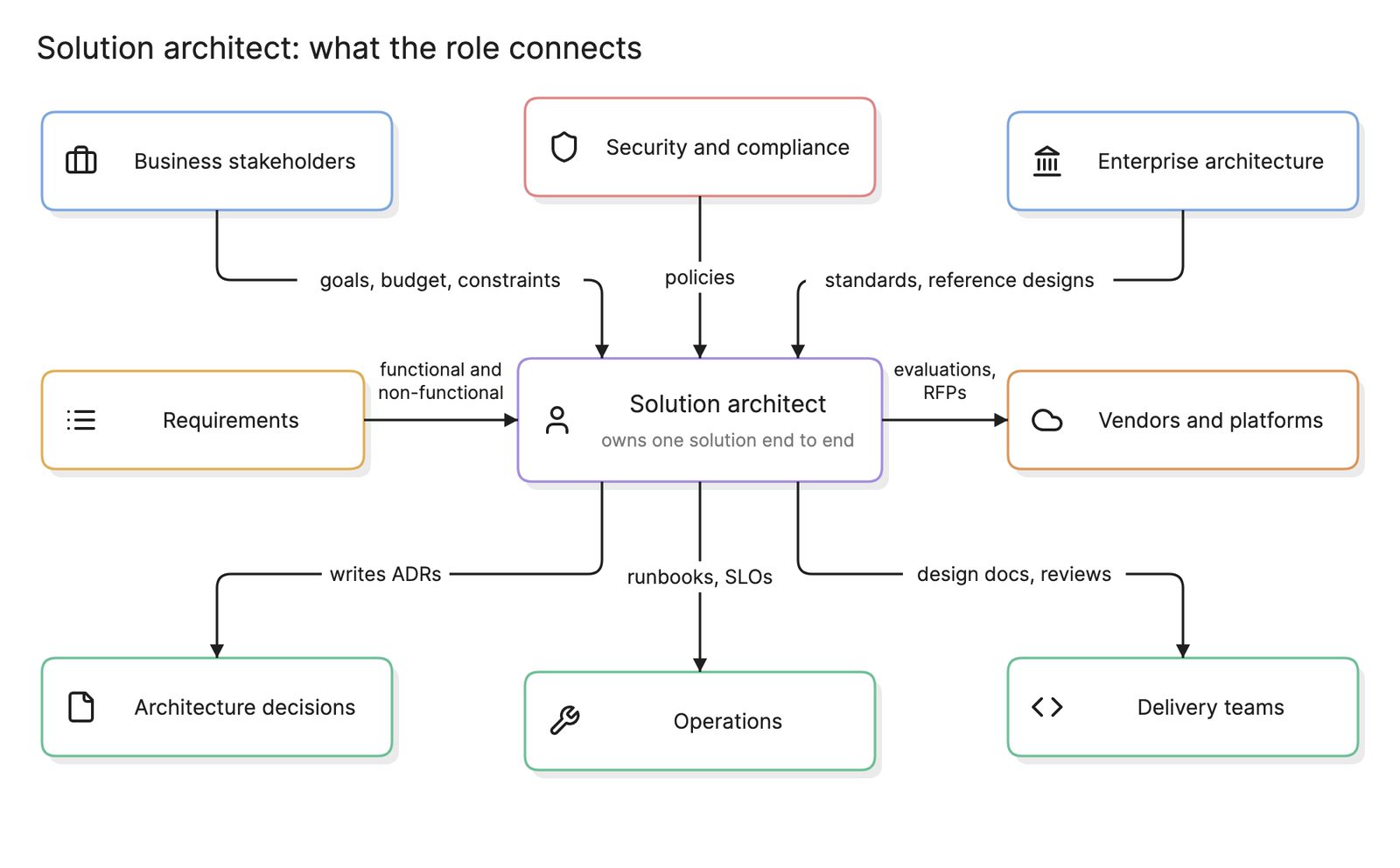
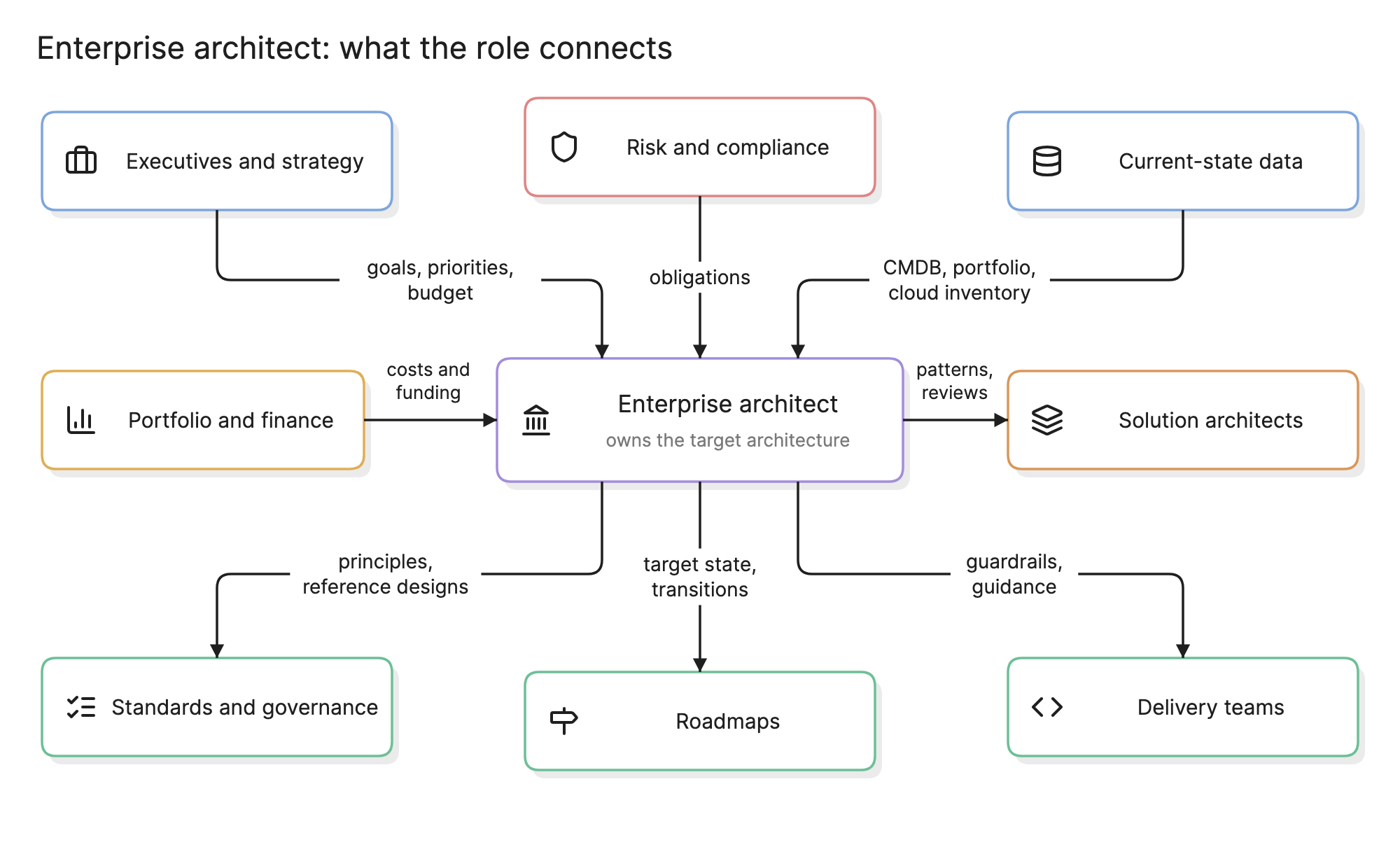
The diagram at the top of this page maps the role. The architect sits in the middle because the job is to connect the people who set direction with the people who build systems, and the two groups rarely talk directly.
Inputs arrive from the top and left. Executives supply goals, priorities and the budget envelope. Risk and compliance supply obligations the architecture must meet. Current-state data arrives from the CMDB, the application portfolio and cloud accounts, which grounds the target in what actually runs. Portfolio and finance supply demand, costs and the investment cases that need an architecture view.
Outputs go to the right and bottom. Solution architects get patterns and design reviews. Standards and governance get principles and reference designs. Roadmaps get the target state and the transition states on the way to it. Delivery teams get guardrails and guidance. The architect owns everything on the output side.
What skills does an enterprise architect need?
- Breadth across all four domains. Enough understanding of operations, data, applications and infrastructure to see how a change in one lands in the others.
- Business and financial literacy. Reading a profit and loss statement, building a total cost of ownership model and talking to a divisional head in that person’s terms.
- Modeling and abstraction. Producing a business capability map, a current vs future state architecture and a landscape diagram a non-architect can read.
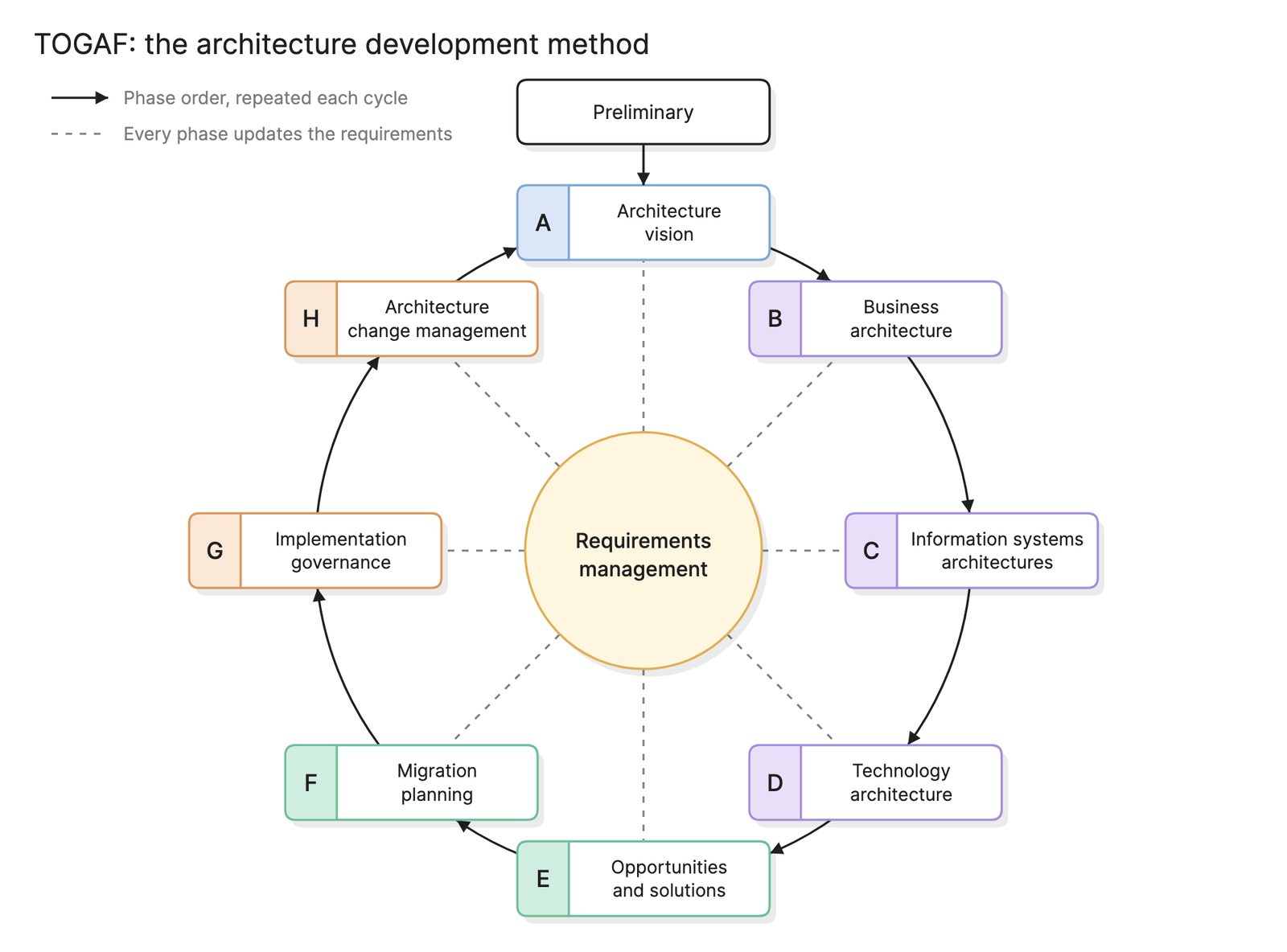
- Platform judgment and method. Knowing the cloud, integration and enterprise application markets well enough to call a platform decision, and a framework such as TOGAF used loosely to give the work a repeatable shape.
- Persuasion and patience. Most of the role’s outputs are recommendations. Getting them adopted takes alliances, timing and a tolerance for decisions that take a year.
What does an enterprise architect deliver?
| Deliverable | What it is | Who uses it |
|---|---|---|
| Capability map | One-page model of what the organization does, with heat for investment or pain | Executives, portfolio planning |
| Application portfolio | Every application with owner, cost, lifecycle and capability support | Finance, rationalization projects |
| Target architecture | The intended business, data, application and technology landscape | Solution architects, program leads |
| Roadmap | Transition states and projects over three to five years | Portfolio board, delivery leadership |
| Principles and standards | The rules projects design within, with architecture diagrams of the reference designs | Review board, every project |
How does an enterprise architect differ from other roles?
| Role | Scope | Horizon | Main output |
|---|---|---|---|
| Enterprise architect | The whole organization | Three to five years | Target architecture, standards, roadmap |
| Solution architect | One business problem and the systems that solve it | One program, 6 to 18 months | A solution architecture and its decisions |
| Software architect | One system or product and its internal structure | The life of the product | A system architecture and its patterns |
| Chief technology officer | Technology strategy, the engineering organization and its budget | Years | Direction, hiring, investment choices |
The enterprise architect sets the rules the solution architect designs within and reviews the result. The software architect works inside one of the systems the solution combines. The CTO owns the technology organization and its budget, and the enterprise architect is often the CTO’s or CIO’s main adviser on where that budget should go. In a smaller company the CTO holds the role personally.
What does a day in the role look like?
A representative day at an insurer. The morning is the architecture review board, where a claims platform replacement is up for approval; the architect’s question is whether the design keeps claims data in the new customer data hub or creates a third copy. Then an hour with finance, agreeing which of three underwriting tools gets retired. After lunch, a session with the data architect on the target state for customer data, and a roadmap update because the mainframe migration has slipped a quarter. The day ends with a one-page brief for the executive committee on what the direct sales strategy needs from the application landscape, with the capability map heat-mapped to show the gaps.
What is the career path for an enterprise architect?
Most enterprise architects come up through solution architecture or through a domain role such as data or infrastructure architect. Some arrive from consulting with a strategy background and add technical depth on the job. From the role, the usual moves are head of architecture, a CTO or CIO post or a transformation role on the business side.
What tools does an enterprise architect use?
- EA repository tools. A dedicated platform holds the capability map, application portfolio, standards and their relationships, with reports for each audience.
- CMDB and discovery tools. The source of truth for what runs today. The architect overlays business meaning rather than maintaining a second inventory.
- Connected architecture maps. Tools like Eraser for enterprise architects draw the application and infrastructure landscape from a CMDB, cloud accounts and other live sources, so the current-state view the architect presents is the one that actually exists.
For more on this kind of diagram, see architecture diagrams.
Frequently asked questions
-
Is an enterprise architect a technical role?
Yes, but the technical work is breadth rather than depth. An enterprise architect has to judge a platform choice, read an integration design and understand what a cloud migration costs without building any of it. The role adds strategy, finance and persuasion on top of a technical base, and people who lack the base lose the trust of delivery teams fast.
-
What certifications do enterprise architects have?
TOGAF certification is the common one, because many large organizations and public bodies ask for it in job descriptions, and cloud provider architect certifications are frequent too. None substitutes for a track record of target architectures that were actually delivered, which is what hiring managers who have run the function look for.
-
How many enterprise architects does an organization need?
Far fewer than solution architects. A common pattern is one lead enterprise architect plus a domain architect each for business, data, applications and technology, or one per major division. Four to eight covers most organizations of a few thousand people. Larger teams tend to produce more documents, not better decisions.
-
Does an enterprise architect report to the CIO?
Usually, either directly or through a head of architecture, though some organizations place the role under the CTO or a strategy office. What matters more than the reporting line is a seat in the forums where investment decisions are made, because an architect who hears about the budget after it is set can only react.