IT management
TOGAF
TOGAF is The Open Group's enterprise architecture framework, built around the architecture development method, a repeatable cycle for planning change.
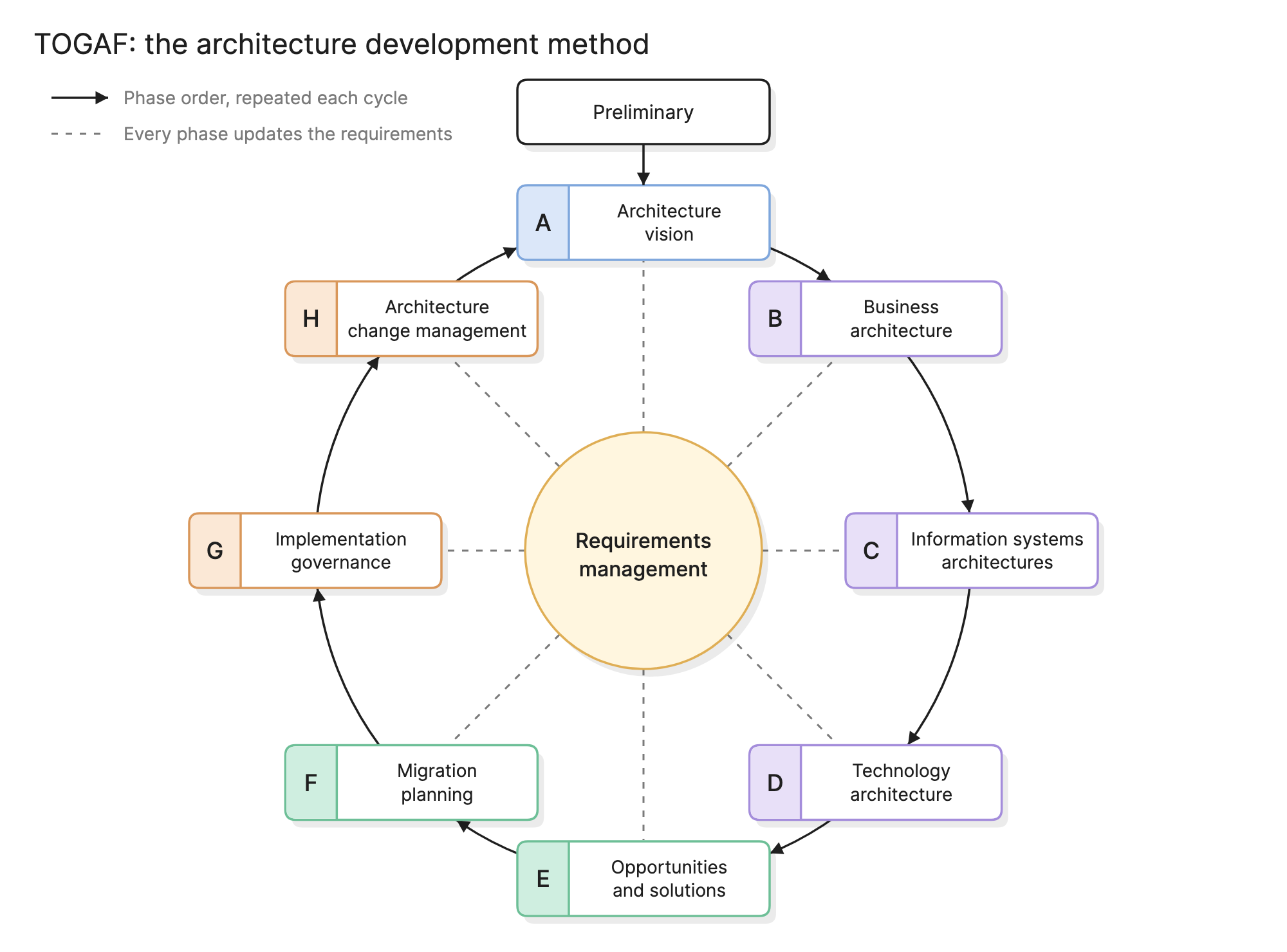
Architecture teams adopt TOGAF because it gives enterprise architecture a shared vocabulary and a repeatable sequence of steps, which matters when the work spans years, several teams and a rotating cast of stakeholders. It is also the framework hiring managers expect an enterprise architect to know, so it is useful even for teams that do not follow it closely.
What is TOGAF?
TOGAF is a published standard from The Open Group that describes how to develop and govern an enterprise architecture. It has four main parts:
- The architecture development method (ADM). The cycle at the top of this page: phases that take an architecture from vision to delivery and back around.
- ADM guidelines and techniques. Advice on applying the method: iteration, stakeholder management, gap analysis and adapting the cycle to agile delivery.
- The content framework. A model of the artifacts the ADM produces and the building blocks they describe, so two teams produce comparable outputs.
- The enterprise continuum and repository. A way of organizing reusable architecture assets from generic to organization-specific, and the repository that holds them.
What are the phases of the ADM?
| Phase | Name | What it produces |
|---|---|---|
| Preliminary | Preliminary | The architecture capability: principles, governance and the framework tailored to the organization |
| A | Architecture vision | Scope, stakeholders, a high-level vision and approval to proceed |
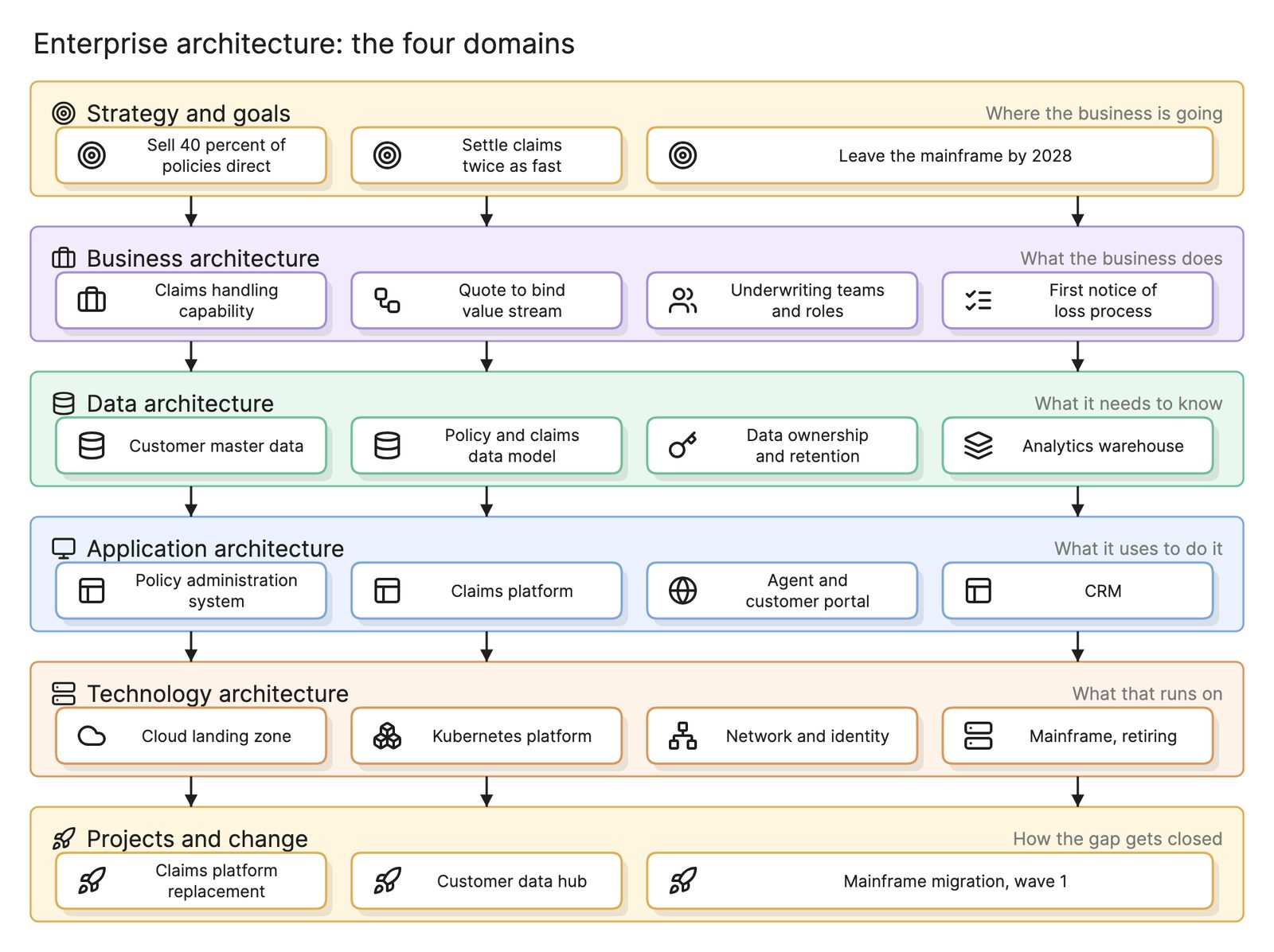
| B | Business architecture | Baseline and target business architecture: capabilities, value streams, organization and processes, with the gaps |
| C | Information systems architectures | Baseline and target data and application architectures, drawn from the CMDB and application portfolio, with the gaps |
| D | Technology architecture | Baseline and target technology platforms, with the gaps |
| E | Opportunities and solutions | Gaps grouped into work packages and transition architectures, with build versus buy decisions |
| F | Migration planning | The IT roadmap: work packages sequenced, costed and assigned to projects |
| G | Implementation governance | Compliance reviews of projects against the architecture, with deviations recorded |
| H | Architecture change management | Monitoring change and deciding whether it needs a new cycle or a small update |
| Center | Requirements management | The requirements every phase reads, adds to and validates |
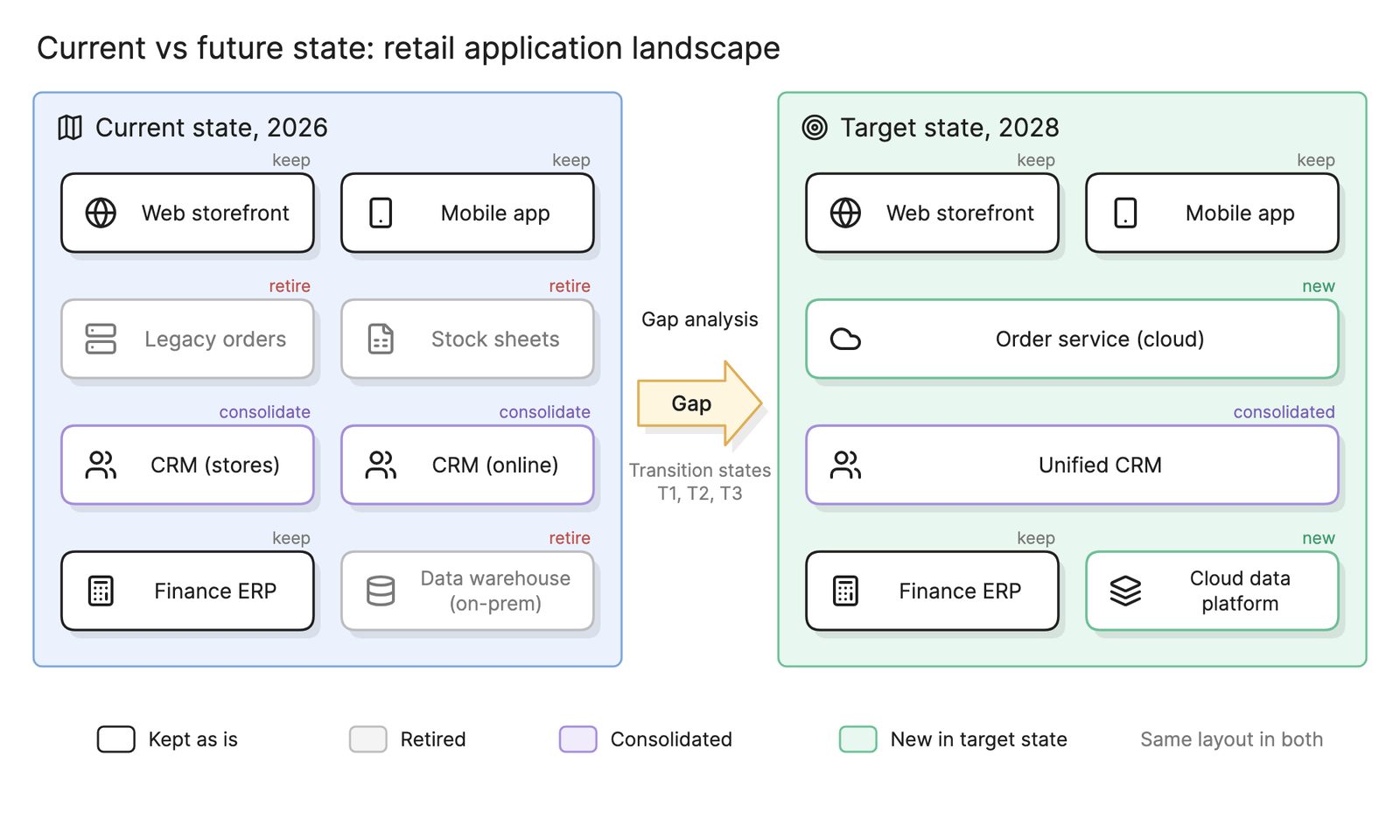
Phases B, C and D share one shape: describe the baseline, describe the target, find the gaps. That pattern is what most teams keep even when they drop the rest. See current vs future state architecture.
How do you read the ADM diagram?
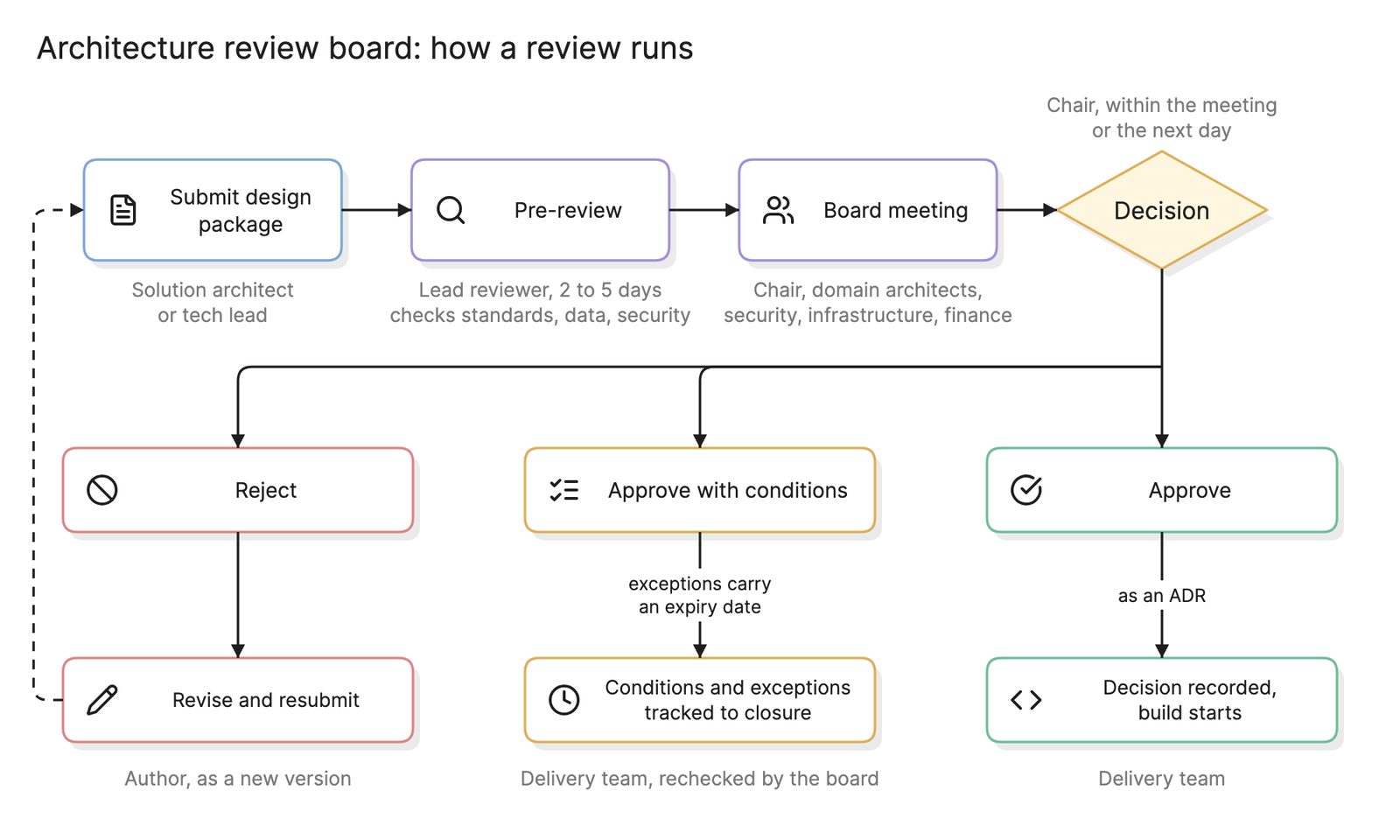
Start at the preliminary phase above the ring, which runs once to set up principles, governance and the tailored method. Phase A opens a cycle by agreeing what this work covers and who cares about it. Phases B, C and D describe baseline and target for each domain, and E and F turn the combined gaps into work packages and a sequenced roadmap. Phase G follows projects as they build, checking designs against the architecture through something like an architecture review board, and H decides when to start the ring again. Requirements management sits in the middle with a dashed line to every phase because requirements are discovered and revised throughout, not fixed at the start.
What else is in TOGAF?
The content framework
The content framework defines three kinds of output. Building blocks are the reusable parts of an architecture, such as a capability, an application or a platform service. Artifacts are the catalogs, matrices and diagrams that describe them, such as an application portfolio catalog or a deployment diagram. Deliverables are the documents that bundle artifacts for sign-off. The content metamodel says how building blocks relate, which is what lets a repository tool hold them.
The enterprise continuum
The enterprise continuum classifies assets from generic to specific: foundation architectures that apply anywhere, common systems architectures for shared concerns such as security, industry architectures and organization-specific ones. A matching solutions continuum does the same for the products that implement them. The idea is to reuse from the generic end before building at the specific end.
Certification
The Open Group runs a certification program against the standard. For the 10th Edition the levels are TOGAF Enterprise Architecture Foundation, which tests the vocabulary and structure, and Practitioner, which tests applying the ADM to scenarios. Certification shows familiarity with the standard; it does not by itself demonstrate experience delivering an architecture.
What are the criticisms of TOGAF?
- Weight. Followed literally, the ADM produces many deliverables per cycle. Organizations that complete each one before moving on can spend a year on phases A to D with nothing delivered.
- Document-centric. The standard describes outputs as documents and catalogs, which can turn architecture into records-keeping rather than a stream of decisions.
- Abstraction. The metamodel and continuum are general enough to describe anything, which leaves teams to work out what to actually draw.
- Fit with iterative delivery. The ring predates continuous delivery. The guides on agile and iteration address this, but teams still have to design their own fast path.
Most of these are criticisms of adopting the framework wholesale. Teams that keep the baseline-target-gap pattern, the phase checklist and the vocabulary and treat the rest as reference tend to report fewer of them.
When should you use TOGAF?
TOGAF fits organizations that need a defensible, repeatable architecture process: regulated industries, public bodies that must show how decisions were made and large enterprises coordinating many programs over years. It is also a reasonable starting point when building an architecture function from nothing. It fits less well for a single product company, a small platform team or a program with a short horizon, where a solution architecture and a handful of architecture decision records carry the same information with far less ceremony.
What tools support TOGAF?
- EA repository tools. Platforms built on the content metamodel hold building blocks, artifacts and their relationships and can generate the catalogs and matrices the standard describes.
- Modeling tools. ArchiMate, also from The Open Group, is a notation designed to pair with TOGAF, and several modeling tools support both.
- AI diagramming tools. Tools like Eraser generate the baseline and target architecture diagrams phases B to D call for from a written description or from live infrastructure, which keeps those artifacts current between cycles.
For more on this kind of diagram, see architecture diagrams.
Frequently asked questions
-
What does TOGAF stand for?
TOGAF stands for The Open Group Architecture Framework. The Open Group, a vendor-neutral consortium, published the first version in 1995, derived from a United States Department of Defense framework called TAFIM. The current release is the TOGAF Standard, 10th Edition, from 2022, which split the content into a stable core and extendable guides.
-
What is the difference between TOGAF and Zachman?
Zachman is a classification scheme: a grid of six questions against six perspectives that says which artifacts an architecture could contain, with no process for producing them. TOGAF is primarily a method, the ADM, with a content framework attached. Some organizations use Zachman to organize their repository and TOGAF to run the work.
-
Do you have to follow every ADM phase?
No. TOGAF describes itself as a framework to be tailored, and the preliminary phase exists partly to decide which parts apply. Most organizations keep the phase sequence as a checklist, run several phases in one short cycle for small changes and skip formal deliverables where a diagram and a decision record do the job.
-
Is TOGAF still relevant?
It remains the most widely recognized enterprise architecture framework and the most common certification in architecture job descriptions, especially in large enterprises, government and financial services. Its vocabulary is shared ground between architects from different organizations. Whether the full method fits a given organization is a separate question, and many teams use it selectively.